

 Amita Makan
Āvāhana – Invocation 2021
 Dak'Art 2018 Dak'Art 2018
 ART FOR THE WORLD ART FOR THE WORLD Aqua 2018  Art Genève 2017 Art Genève 2017
 Ubuntutu 2016 - 2017 Ubuntutu 2016 - 2017
 Vasant 2016 Vasant 2016
 Artivism For Breast Cancer 2016 Artivism For Breast Cancer 2016
 Nomalungelo: Threads to Freedom Nomalungelo: Threads to Freedom
 Trans-Africa Trans-Africa
 ME 3 Exhibition ME 3 Exhibition
 Pointure Pointure
 Evanescence Evanescence
 Luciano Benetton Foundation Small Canvas Project Luciano Benetton Foundation Small Canvas Project
 Giant Protea Giant Protea
 Loose Ends II Loose Ends II
 Phillip Tobias: After John Liebenberg Phillip Tobias: After John Liebenberg
 France - South Africa dialogue France - South Africa dialogue
 Neo - Eclectic Exhibition Neo - Eclectic Exhibition
 African Renaissance: KKNK African Renaissance: KKNK
 Mandela Mandela
 Makeba Unveiling: UNISA Makeba Unveiling: UNISA
 Australopithecus sediba Australopithecus sediba
|
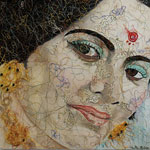
Press ArticlesIndia/South Africa Supplement to Mail and Guardian September 10-16 2010. A Journey of Discovery By Themba ka Mathe in A Cultural Bridge: India/South Africa Supplement to Mail and Guardian September 10-16 2010. A few months ago, Amita Makan would not have imagined herself embarking on the rare and notable journey of self discovery and heritage search. A chance meeting with South Africa-based journalist and sociologist, Hyderabadi, Vidya Bhandarker propelled a burning desire, inspiration and urge for Port Elizabeth born Makan to trace her lineage using her profession of art. The long and tortuous journey of her ancestors over a century ago has become an incredible and constant source of inspiration to her work, and journey of lineage tracing. A fourth generation South African Indian, Makan turns the gallery walls at the SANAVA gallery in Pretoria into a time and direction pointing campus of some sort. She deliberately used her mixed media work titled “Journey” - a painted pair of ornate Indian ladies’ sandals, over which she embroidered excerpts of the Freedom Charter across it and used embroidery as a statement to express both her political identity and personal heritage. At one level, her work acts as a tribute to those pioneers, including her great grandfather, who left India to the unknown lands of Africa. “‘Journey’ is an allegory of my ancestry, my caste, of migration and mobility; and the long journey travelled by my family and many other South Africans of Indian descent,” she says. “The very fact that I am able to pursue my love to create art is due to the sacrifices made by my ancestors.” As a black South African woman of Indian ancestry living in post-apartheid South Africa, Makan feels working on the piece gave her an opportunity to contemplate her multi-layered identity within the context of the 150 years of Indians’ presence in South Africa. “It is an opportunity to reflect on our Indian ancestors, their arrival during the time of colonialism, and the discrimination and hardship they faced under apartheid. Despite their difficulties they endured over a century and a half, they remained resilient. They were determined to make South Africa their home.” Amita’s great grandfather Makan Bhana arrived in South Africa in 1901 with a little bag; his indigenous language, and shoe making tools. He made his way to Port Elizabeth, a British colony at the time, and was required by law to obtain a permit to repair shoes and boots. By 1914, he had established retail and wholesale businesses in clothing and shoes in South End, a mixed residential area founded on prime land in Port Elizabeth. Their businesses and homes were bulldozed and razed to the ground under the Group Areas Act and the residents were relocated to far flung, barren, racially segregated areas. The entire community history spanning generations was erased. Looking at the body of Makan’s work – that include a series called ‘Evanescence’, portraits of her late mother, a traditional Indian woman who wore saris – there is an interesting projection of the inventory of her life experiences as a black South African woman of Indian origin. The 42-year-old Pretoria based artist belongs to that privileged generation of South African Indians that were able to attend university, yet her respect for her tradition and heritage is sacrosanct. Growing up under apartheid, her first formal introduction to art was through a one year course she took in Fine Art and History of Art at Rhodes University, after which she completed a Masters Degree in International Relations and Political Science. “My love of art is almost instinctive. I loved painting and drawing as a child, but my exposure to art was very limited. Art was not offered as a subject at the government schools. The galleries and best libraries were located in the former white suburbs, “she says. Despite having travelled widely, stayed in Switzerland for some time, and being exposed to different European painting techniques and styles, Makan has gone back to her roots of using embroidery and stitching. “My embroidered works are also conceptually rooted.” The canvas, or rather the fabric, she uses often has symbolic value, it is perhaps only the subject matter, composition, materials and the style that make the work contemporary. “I love the repetitive, almost meditative, act of stitching. I embroider in the manner similar to that in which I paint, but often using my own photographs and old family photographs,” says Makan. Although, she learnt embroidery at primary school and took it up again in 2008 to do a portrait of her Alzheimers ailing mother, Makan traces her love for embroidery and stitching to her ancestors. |
Website of South African Artists |
 |