

 Amita Makan
Āvāhana – Invocation 2021
 Dak'Art 2018 Dak'Art 2018
 ART FOR THE WORLD ART FOR THE WORLD Aqua 2018  Art Genève 2017 Art Genève 2017
 Ubuntutu 2016 - 2017 Ubuntutu 2016 - 2017
 Vasant 2016 Vasant 2016
 Artivism For Breast Cancer 2016 Artivism For Breast Cancer 2016
 Nomalungelo: Threads to Freedom Nomalungelo: Threads to Freedom
 Trans-Africa Trans-Africa
 ME 3 Exhibition ME 3 Exhibition
 Pointure Pointure
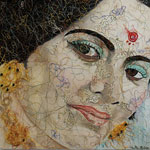 Evanescence Evanescence
 Luciano Benetton Foundation Small Canvas Project Luciano Benetton Foundation Small Canvas Project
 Giant Protea Giant Protea
 Loose Ends II Loose Ends II
 Phillip Tobias: After John Liebenberg Phillip Tobias: After John Liebenberg
 France - South Africa dialogue France - South Africa dialogue
 Neo - Eclectic Exhibition Neo - Eclectic Exhibition
 African Renaissance: KKNK African Renaissance: KKNK
 Mandela Mandela
 Makeba Unveiling: UNISA Makeba Unveiling: UNISA
 Australopithecus sediba Australopithecus sediba
|
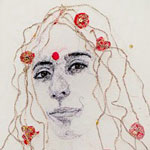
Press ArticlesA Mother Remembered by Omeshnie Naidoo in Good Life Supplement, The Mercury, 25 May 2010 VASANTI Dhanjee Makan was diagnosed with Alzheimer's disease in 1997, at the age of 56, just one year after recovering from breast cancer. Over time, the insidious disease assailed her thinking, memory and behaviour, and for her daughter, Amita Makan, the silent mourning of the loss of her mother began. However, Amita says when her mother visited her at her Pretoria home in 2002, bringing two gifts - a heart-shaped jewellery box and an envelope containing two sepia pictures of herself as a young wife and mother - the gesture offered a purposeful elucidation. "Of all her worldly possessions these photographs were most precious to her. I wondered why she so lovingly entrusted them to me. "I realised that it was her way of asking me to remember her as she was forgetting herself," says Amita. The gifted artist who has not had a solo exhibition before this one and, in fact, pursued political science and English as a student, began to paint her mother, to "paint her small story" as she calls it - of youth, age and the interruption of illness - which is ultimately the story of human existence and hope in adversity. Painful Amita, who studied fine arts at the Rhodes and at the University of Pretoria, painted what was dissolving during the 12-year period that Alzheimer's eroded her mother's sense of self. "It was painful for the family to watch. My mother wore saris daily and would drape the six metres of fabric with finesse, but as the disease took hold the sari began to hang lopsided over her body. "She made desperate visits to the optometrist, not knowing that her fading eyesight was neurological and symptomatic of the disease. She was losing her ability to hold things, to speak, to write, to read, to remember, to drive and to tell time. "There were desperate notes scattered throughout the house with half-written prayers, indecipherable recipes, incorrect telephone numbers, misspelt names and partial addresses." In time, she would forget her children. Amita says the paintings became an expression of her own grieving. The pictures of her mother in the exhibition, titled Evanescence, are photorealist and the artist says this was born out of an attempt to preserve and immortalise her mother in the face of steady deterioration. As author Susan Sontag once said about photography, "All photographs are memento mori. To take a photograph is to participate in another person's mortality, vulnerability, mutability. Precisely by slicing out this moment and freezing it, all photographs testify to time's relentless melt." One such painting, My mother in Doodles, is an oil portrait, hand embroidered over with silk thread that symbolises her mother's unravelling. It also resembles the plaques and tangles that Alzheimer's weaves across the brain. The fully embroidered pieces Sleep and Suspended are embroidered in single threads of fine silk, symbolising that all things are susceptible to time and echoing the impermanence of life. The painstaking stitch by stitch process mimics the stealth of the disease itself. No doubt many will relate to Amita's work and her personal feeling of loss, but perhaps even more will be inspired by her efforts to remember her mother.
Something on my mind: Kate Jowell - A battle with Alzheimer's
Something on my mind is a book as much about triumph as it is about tragedy - author Sharon Sorour-Morris relates the life of Kate Jowell, the first woman to hold the post of director of the University of Cape Town's Graduate School of Business and, later, editor of magazine Fair Lady, and her battle with Alzheimer's. The book captures the essence of this strong woman while recording her mental decline and the effects of the disease on her life and that of her family, friends and caregivers. At Jowell's first meeting with the author she says, "What I understand about Alzheimer's - and this is the only thing I understand about Alzheimer's - is that I've got plaque on the brain". Alzheimer's is an affliction of the brain and all its signs and symptoms are caused by damage to the cells of the brain. This disease impairs the function of these cells at microscopic level, causing the deterioration in mental ability and behaviour that we observe on a day-to-day basis. For Jowell, at first it meant being absent-minded about things, then it slowly progressed to forgetting herself, her life and even her children. For a woman with such a sharp mind, it meant simple things like not being able to climb stairs, write a note or make a cup of tea. In his forward to David Shenk's definitive work on the disease, The Forgetting - understanding Alzheimer's: A Biography of a Disease, Adam Phillips explains: "We don't think of ourselves as having to remember our own names, or where we live, or how to eat or read. And yet, memory - all the skills and impressions we so carefully acquired in the past - informs much of what we do." The markers for Alzheimer's disease are the plaques and destructive fibres called neurofibrillary that accumulate in the brain and slowly but surely kill the brain's neurons, the nerve cells of which it is largely composed. These neurofibrillary tangles were first identified by German neurologist Alois Alzheimer in 1905. The disease struck Jowell in her 50s. In much the same way that artist Amita Makan (see story above) pieces her mother's life together, Sorour-Morris gathers from the people around Jowell - and often the woman herself - the pieces of her life. Her youth in England, her relationship with constitutional court judge Albie Sachs, life in London, marriage, her high-flying career and motherhood. Poignant about the novel is the author's journey - how much she discovers about her protagonist from those who were a part of her life, hearing all that she's achieved and understanding her strength of character, all the while watching her lose her mind. |
Website of South African Artists |
 |